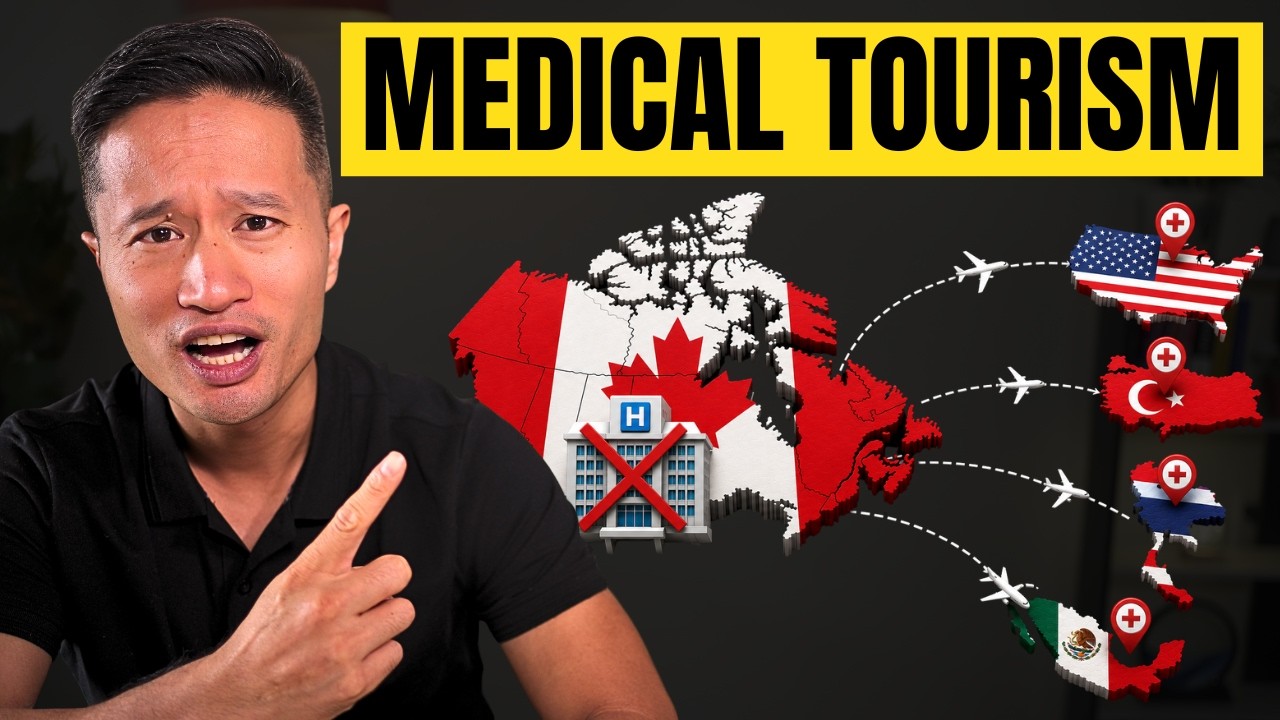
In 2025, an estimated 105,529 Canadians received non-emergency medical treatment outside Canada, about 66% higher than in 2016. If Canadian health care is “free,” why are so many paying out of pocket elsewhere?
We’ll look at why they’re going, where they’re going, what they’re getting done, and why for some, this becomes part of a bigger decision to leave Canada. I’m a financial planner, not a doctor.
The Real Cost of “Free” Care
Before we talk about Canadians flying abroad for medical care, start with Shannin Desroches.
She was only 26 when severe stomach pain sent her looking for answers. According to reporting, she pushed for more testing, including a CT scan, but the appointment she was given was about a year away. She said she knew with her symptoms she “wasn’t going to make it” to that scan.
Before that date arrived, she got an MRI through the help of a family friend. Doctors found a blockage, admitted her, and an emergency colonoscopy revealed a tumour so large the scope could not pass through. That is when she was diagnosed with stage 4 colon cancer.
Today, Shannin is still fighting. After dozens of rounds of chemotherapy, she is now raising money to travel to California for a specialized procedure her doctors there believe could help. As a Canadian, it is entirely out of pocket, roughly $70,000. A young woman who waited too long inside the system is now paying tens of thousands to go outside of it.
Now, we can’t know exactly how her case would have played out with earlier testing. Maybe the outcome would have been the same. Maybe doctors would have found it sooner. But that is the terrifying side of wait times.
Waiting for a knee replacement is painful.
Waiting when something serious is growing inside you is different.
One report found that more than 17,000 patients died while waiting for surgeries, procedures, scans, or specialist appointments in a single year.
That does not mean every death was caused by the wait. But it does show the real cost of “free” care.
Free care and timely care are not the same thing.
What Canadians Are Actually Going Abroad For
So what are Canadians actually going abroad for?
It usually falls into a few buckets.
1. Pain
A lot of the time, it starts with pain.
Take Mark Chuiko, from Alberta. He wrote that he was facing an estimated two-year wait for hip surgery. Private surgery in Canada would have cost about $30,000 per hip. So he went to Lithuania instead, where two hip surgeries cost about $22,000 total.
For him, this was not about luxury care. It was about getting his mobility back, working again, and being able to parent normally.
A hip, a knee, a back problem, a shoulder injury, these may not always be classified as emergencies. But they can still take over your life.
2. Answers
Then there are people looking for answers.
MRIs, CT scans, PET scans, specialist opinions, and second opinions.
Dean Simpson, from Manitoba, injured his back and was told he would wait months just to learn how much longer he would wait for an MRI. So he and his wife flew to Mexico, where he got an MRI and surgery within days.
It cost more than $30,000, but he said the pain was gone.
3. Cost
Dental work is one of the clearest examples. Implants, crowns, bridges, veneers, and full-mouth restorations can be extremely expensive in Canada.
When the quote at home is massive, and another country can do the work faster and cheaper, it is not hard to see why people start looking.
4. Fertility
Fertility is another one.
IVF, donor eggs, genetic testing, and shorter timelines can push Canadians abroad because fertility has a clock on it. Age matters. Failed cycles matter. Donor access matters.
For people trying to have a child, waiting is not just frustrating.
It can feel like the odds are slipping away.
5. Elective Procedures
And yes, some Canadians go abroad for cosmetic surgery, hair transplants, veneers, weight loss surgery, and other elective procedures too.
Some of this is about price. Some of it is about access. Some of it is about wanting a specific clinic, surgeon, or package.
But the pattern is clear.
Sometimes Canadians are shopping for a lower price. Sometimes they are shopping for speed. Sometimes they are shopping for treatment they cannot easily access at home.
But a lot of the time, they are shopping for certainty.
Where Canadians Go
Where Canadians go usually depends on what they need. There is no perfect country-by-country ranking for Canadian medical tourism, so think of this as the practical map, not a definitive leaderboard.
For people with money, the United States is the obvious option for diagnostics, cancer care, specialist opinions, and speed. It is close, English-speaking, and easy to navigate, but usually expensive.
Mexico is another major destination, especially for dental work, back surgery, weight loss surgery, and diagnostics. It is also familiar to many Canadians who already spend time there.
For orthopedic problems, places like Lithuania and parts of Eastern Europe come up for hip and knee replacements.
For cosmetic and aesthetic work, Turkey is common for hair transplants, cosmetic surgery, and dental care, though Canada warns that some travellers have had serious complications after surgery there.
South Korea is also a major aesthetic destination. Reuters recently described Seoul’s medical-tourism boom as being driven by K-beauty treatments like lasers, Botox, and skin lifting. Source
Thailand, India, and Malaysia have long been established medical tourism hubs too, with large private hospital systems and international-patient programs. Malaysia even has a government-backed healthcare travel council promoting the sector. Source
And for fertility treatment, countries like Barbados, Greece, and Spain come up because of shorter waits, donor access, different rules, and lower prices.
The destination changes, but the reason is usually the same: faster access, lower cost, or treatment options they couldn’t easily get in Canada.
The Money Math
Medical tourism is not just a health decision. It is a financial decision.
Here is the rough math:
| Treatment | Canada / private option | Abroad example | Why people look abroad |
|---|---|---|---|
| MRI scan | Around $780 privately | Buffalo-area MRIs around $500 to $1,000 CAD | Faster answers |
| Hip surgery | Around $30,000 per hip privately | Lithuania example: about $22,000 for two hips | Lower cost, shorter wait |
| Back surgery | Public waits can be months | Mexico example: over $30,000 for MRI plus surgery | Fast access |
| Dental implants / major dental | Can run into the tens of thousands | Mexico clinics often advertise 50% to 70% savings | Lower out-of-pocket cost |
| IVF | Often $10,000 to $20,000 per cycle | Barbados lists IVF at US$6,650 and IVF with ICSI at US$7,650 | Price, donor access, timelines |
| Hair transplant / cosmetic | North American quotes often reach five figures | Turkey hair transplants are often quoted around $4,000 to $5,000 USD | Price, packages, reputation |
For diagnostics, the value is speed. Paying $500 to $1,000 for an MRI can feel worth it if it gets you answers weeks or months sooner.
With surgery, the stakes get bigger. If private hip surgery in Canada is around $30,000 per hip, but a foreign clinic offers two hips for roughly $22,000 total, the math starts to look very different.
Back surgery is similar. In the Mexico example, the bill was over $30,000, so it was not cheap. But the patient was paying for speed: MRI, diagnosis, and surgery within days instead of waiting months.
Dental is the clearest cost story. If implants, crowns, or full-mouth reconstruction cost tens of thousands in Canada, and Mexico advertises savings of 50% to 70%, the pull is obvious. I have done this myself, so I understand the appeal.
Fertility has a different clock. If IVF in Canada can run $10,000 to $20,000 per cycle, but a clinic abroad lists IVF around US$6,650, people do not just see a lower price. They see another chance.
And cosmetic procedures are the classic medical tourism market: hair transplants, veneers, plastic surgery, and skin treatments, often sold as packages.
But here is the trap.
The sticker price is not the real price.
You still have flights, hotels, companion travel, recovery time, exchange rates, follow-up appointments, and the possibility that the first procedure does not fully solve the problem.
So the real question is not just, “Is it cheaper?”
It is, “What is the all-in cost if everything does not go perfectly?”
Because the cheapest surgery can become the most expensive decision of your life if aftercare, complications, or revision surgery fall back on you.
The Risks Nobody Puts in the Brochure
Medical tourism is not risk-free.
Canada’s own travel guidance warns about infection, surgical complications, unsafe medications, different licensing standards, language barriers, and gaps in follow-up care once you return home.
That matters because surgery abroad is often marketed like a simple package: flight, hotel, clinic, recovery, done.
But what if something goes wrong?
Canada’s Türkiye travel advisory specifically warns that medical tourism is common there and that some Canadian travellers have had serious complications after surgery. And if you come home with incomplete records, complications, or a surgery that needs revision, your Canadian doctor may be left trying to fix a problem they did not create.
This is also where coverage matters. Planned medical procedures abroad are often treated very differently from a normal vacation emergency.
So yes, going abroad can make sense.
But cheap and fast does not always mean safe.
Leaving Canada Means Planning Your Own Healthcare
Leaving Canada means planning your own healthcare.
And this matters because more Canadians are not just flying out for one surgery or scan. They’re thinking about leaving Canada altogether: retiring abroad, lowering costs, chasing better weather, or building a different lifestyle.
But once you leave, healthcare becomes something you have to plan deliberately. Your provincial coverage may be limited or lost. Flying home does not guarantee instant care. And your new country’s system may work completely differently.
That means thinking through local care, private hospitals, international insurance, pre-existing conditions, emergencies, and what happens if you need serious treatment later.
Because leaving Canada is not just changing countries, it’s changing healthcare systems, tax rules, residency obligations, and the entire framework around how you live and retire abroad.
That’s exactly why we created Blueprint Abroad: a course and community designed for Canadians planning a move overseas.
And if you’re looking for personalized help with the tax, financial, residency, and healthcare planning side, that’s what we do at Blueprint Financial.
Explore our financial planning services to see how we can help, and join our free financial newsletter for practical insights on living abroad, retirement, and cross-border planning.
If you found this article useful, consider sharing it with someone who may be thinking about a move overseas, and continue exploring our resources for your next step.