
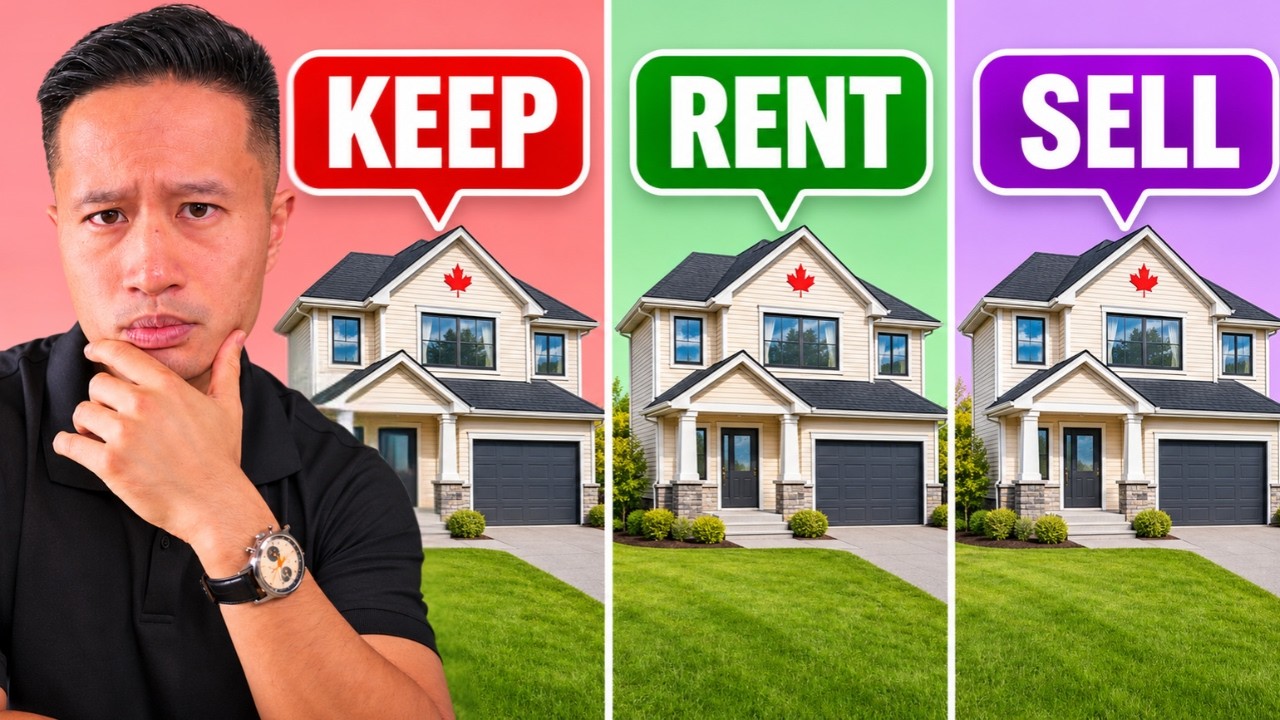
When you leave Canada, what should you do with your home?
Get the timing wrong and you could still owe Canadian tax after you leave or walk away with less cash on closing day than you expected.
We help clients make this decision all the time when they move abroad. I’ll walk you through three options: sell, rent it out, or keep it empty. Then I’ll show you how to plug your own numbers into our free calculator to see which option works best for you.
Meet Leah and Rob
Meet Leah and Rob from Saskatoon. Rob just retired from teaching, and Leah’s ready to leave nursing. They’ve been going back to their home country of Montenegro for years. On their last trip to Kotor, they went from walking the bay each morning to looking at apartments they could actually see themselves living in.
Now they’re planning to move for good, and they’re split on what to do with their $780,000 house. Leah wants to keep it available in case they come back. Rob’s leaning toward renting it out, but he’s open to selling if the numbers or the work involved make it hard to justify.
Option 1: Keep the house available
Let’s start with Leah’s first choice. They leave the Saskatoon house empty, with no tenants. After twenty years, there are memories in every room. If life in Montenegro doesn’t work out, there’s real comfort in knowing they can fly back, turn the key and sleep in their own bed.
But what are they paying for that option? The mortgage is $1,700 a month. Add $350 in property tax, $150 for insurance, $150 for maintenance and another $150 for utilities and someone to check on the place.
If you want to follow along, open the free calculator. You can load Leah and Rob’s example or plug in your own numbers.
For them, that’s $2,500 a month, or $30,000 over the first year. And they still have to pay for somewhere to live in Montenegro.
So here’s the question I’d ask them. If you’re planning to move for good, how much of your first year’s budget are you willing to spend keeping your old home ready for you? And at what point would you feel comfortable letting it go?
If their goal is to become non-residents, the CRA considers a Canadian home they can still use a significant residential tie. An arm’s-length lease on market terms may give that tie less weight, depending on their circumstances. That’s why keeping it empty is often my least favourite option. They’re carrying a house with no rental income, and it could complicate their claim to non-residency.
So how much would they actually keep if they rented it out?
Option 2: Rent it out
Rob estimates they can get $3,200 a month in rent, and they’ll still have that $1,700 monthly mortgage payment. That looks like a pretty good spread. But let’s see what’s left when you run the house as a rental from Montenegro.
We’ll assume the house is empty five percent of the time. That brings the rent they collect down to an average of $3,040 a month. If the property manager takes ten percent of what they collect, that’s $304. Then there’s $2,550 for the mortgage, property tax, insurance, maintenance and other expenses.
That leaves $186 a month before tax and withholding. They’d still own the house, but if they came back while it was rented, they’d need somewhere else to stay.
In one extreme case, CBC Toronto reported on a couple who rented out their Etobicoke home while working abroad. Fraudsters impersonated them and sold it. They had title insurance, but imagine finding that out from another country.
If they become non-residents, there’s another hit to the cash they see that month. Under the standard gross rent withholding rules, twenty-five percent is withheld. So in a month when they collect the full $3,200, that’s $800 withheld. Their final Canadian tax can be different if they file a return under section 216. And if the CRA approves Form NR6, withholding can be based on net rental income instead.
Send the NR6 by January 1 each year or before the first rent payment is due. Your agent keeps withholding on gross rent until the CRA approves it in writing. Once approved, your section 216 return is generally due June 30 the following year. Miss that deadline and you could owe the balance of the 25% tax on gross rent.
One more thing I’d check before the first tenant moves in. Turning your home into a full-time rental can trigger a deemed sale at market value for tax purposes. A valid election can defer that tax event. So before they sign a lease, I’d want them to know how that conversion would be treated.
Renting can still work, but a lot of people we work with decide the extra admin isn’t worth it. Price out the accountant and any ongoing compliance costs, and add anything you haven’t already budgeted to the calculator’s Other field. An extra $100 a month for those costs would cut their $186 surplus to $86 before tax and withholding. So what if they just sold it?
Option 3: Sell it
Now let’s say Leah and Rob sell. They get $780,000 for the house, pay off the $310,000 mortgage and spend another $30,000 on selling costs. That leaves an estimated $440,000 before any tax or holdbacks.
That’s cash they could free up once, when they sell. It could help them settle in Montenegro. But if they move back to Saskatoon, they’ll be looking for a home at whatever prices are then.
Now, if they sell while they’re still Canadian tax residents and the house qualifies, the principal residence exemption may shelter the gain. If they sell after becoming non-residents, the exemption can still shelter part of the gain based on qualifying years. More years of ownership as non-residents can leave more of the total gain exposed to tax. The calculation generally works by qualifying years, so you can’t simply draw a line at the departure date and assume every dollar before it is exempt. Then there’s a separate question. How much cash can they actually use on closing day?
Say they sell it as non-residents, it’s a non-depreciable home, and there’s no applicable exception or CRA certificate in place. Under the standard purchaser liability rule, the buyer could be liable for twenty-five percent of the purchase price. With no certificate and no exception, I’d plan for the buyer’s side to protect itself with a holdback. On this sale, that could tie up $195,000. If the certificate is in place by closing, that full holdback may be avoidable.
That’s nearly half of the $440,000 Leah and Rob were counting on. The holdback and their final tax bill are separate amounts. But if they’re relying on those proceeds to buy a place in Montenegro, the amount they can access on closing day matters. That’s a conversation I’d have with their lawyer and tax adviser before they commit to a closing date.
Selling is the most popular option we see with clients making a permanent move. Once they factor in managing a property from abroad, the risk of a big repair, and the filings and professional fees they’d pay year after year, many would rather sell. Let’s put all three options side by side and see what would tip the decision for you.
Calculator walkthrough: What should you do with your house?
We’ve seen all three options for Leah and Rob. Before we get to your numbers, watch what happens when I change just one of theirs.
At $3,200 in rent, they’re ahead by $186 a month before tax and withholding. At $2,800, they’re short $156. With their expenses, they need about $2,982 in asking rent just to break even. So before Rob counts on the house bringing in money, I’d want to know what similar homes are actually renting for.
Now, what about your house? Open the free calculator. Under Sell, enter what you think the house would go for, what it would cost to pay off the mortgage, and your selling costs. Under Rent, put in a realistic rent estimate and allow for vacancy, management and repairs. And under Keep, enter what you’d still pay every month with the house sitting empty.
Before you pick, check what you’d actually have at closing, whether the rental still works at a lower rent, and what you’d pay to keep the house available.
The calculator gives you a starting point, but as Leah and Rob’s example shows, timing can make a significant difference to your financial outcome. Whether you decide to sell, rent, or keep your Canadian home, the sequence of those decisions can matter just as much as the choice itself.
If you’re preparing to move abroad, Blueprint Financial offers cross-border exit planning to help you coordinate your property, tax, and financial decisions before departure.
Book a free discovery call to discuss your situation and start building a plan around your goals.
Build the life you want, with the right Blueprint.